
Restaking
Ethereum Restaking 2026: Risks, Rewards, and Best Practices


Introduction: The Rise of Restaking in Ethereum's Evolving Ecosystem
Ethereum staking has undergone a quiet revolution. While most attention remains fixed on ETH prices and Layer 2 adoption, a more fundamental shift is reshaping how Ethereum's security model operates — and how stakers earn yield. EigenLayer alone has attracted over $15.8 billion in total value locked (TVL), making restaking one of the fastest-growing sectors in all of decentralized finance. That number is not a speculative bubble. It reflects a structural innovation that is fundamentally extending what staked ETH can do.
At its core, restaking allows validators and liquid staking token holders to put their already-staked ETH to work securing additional protocols — without unstaking or abandoning the base layer. This concept of shared security means that the enormous economic weight behind Ethereum's consensus mechanism can now bootstrap trust for an entirely new class of decentralized infrastructure. The implications reach far beyond yield optimization.
This guide covers everything you need to make informed decisions about restaking in 2026. We examine exactly how restaking works and why it matters, walk through the complete risk landscape including slashing vectors and smart contract exposure, compare the leading platforms and their trade-offs, and lay out the best practices that professional node operators and institutional stakers are applying right now. Whether you are a solo validator evaluating your options or a protocol architect considering AVS deployment, this is the reference you need.
What Is Restaking and Why Does It Matter?
To understand restaking, start with what regular Ethereum staking already does. When you stake 32 ETH and run a validator, you are putting capital at risk to attest honestly to the state of the Ethereum blockchain. In exchange, you earn protocol rewards — currently averaging between 4.8% and 5% APY depending on network conditions and validator count. Your staked ETH is collateral guaranteeing your good behavior. If you act maliciously or negligently, that collateral can be slashed.
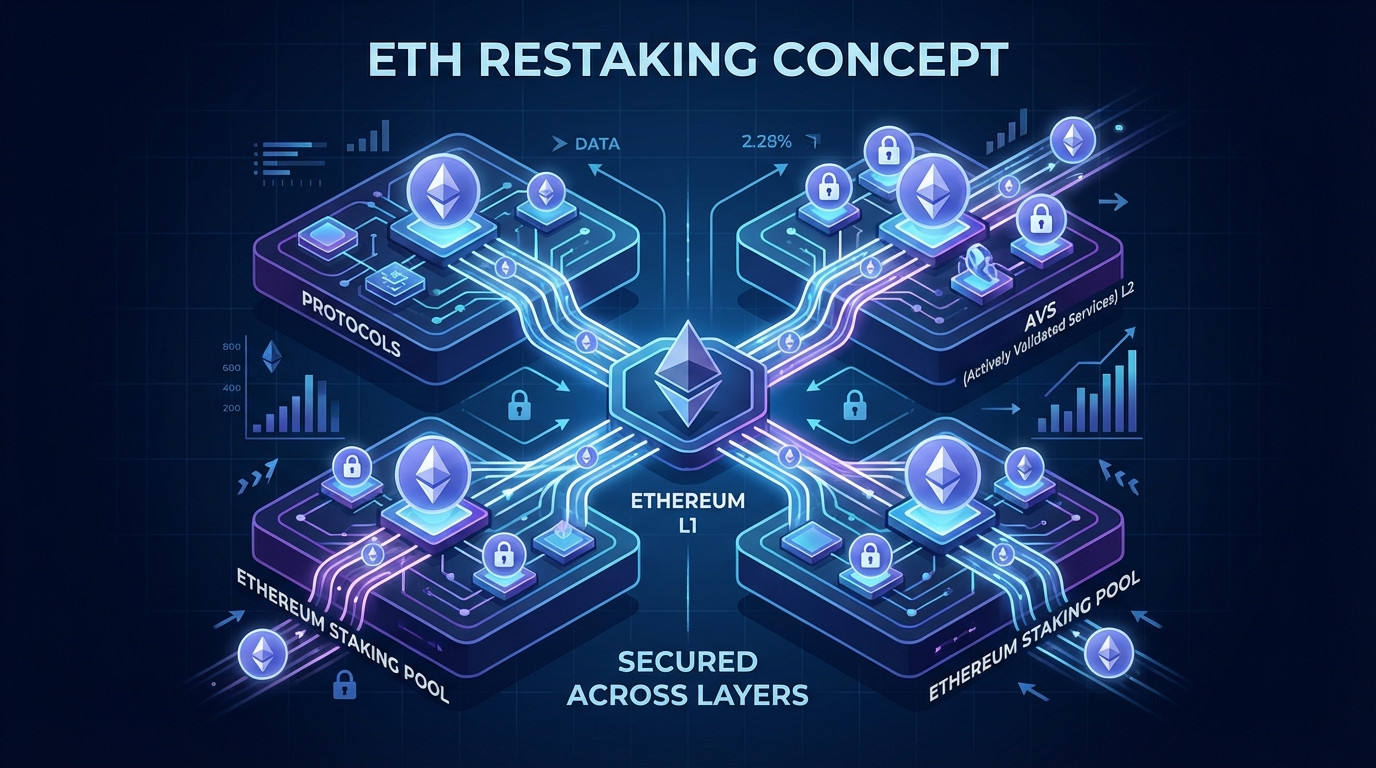
Restaking extends this same economic logic to other protocols. Through platforms like EigenLayer, validators and liquid staking token (LST) holders can opt into additional slashing conditions in exchange for additional rewards. The staked ETH effectively does double duty: it continues securing Ethereum's base layer while simultaneously acting as economic collateral for one or more Actively Validated Services (AVSs).
An AVS is any protocol that requires decentralized trust and validation but does not want to bootstrap its own validator set from scratch. This can include data availability layers, oracle networks, cross-chain bridges, decentralized sequencers, and more. Instead of convincing validators to lock up fresh capital for their specific service, an AVS can tap into Ethereum's existing staker base — inheriting a security foundation that took years and billions of dollars to build.
This is the revolutionary concept behind shared security. Rather than fragmenting cryptoeconomic security across dozens of isolated validator sets, restaking allows that security to be pooled and directed where it is needed. New protocols no longer face the cold-start problem of needing valuable collateral before they can attract users, and users no longer need to trust nascent networks backed by thin economic guarantees.
The scale of adoption reflects this genuine utility. Over 100 teams are actively building AVSs within the EigenLayer ecosystem, spanning use cases from EigenDA's data availability service to decentralized AI inference networks. Each of these services creates demand for restaked ETH, which in turn generates yield on top of base staking rewards.
For stakers, the appeal is direct: enhanced yields that can meaningfully exceed the base 4.8–5% APY benchmark, earned by the same ETH already committed to Ethereum's security. For the broader ecosystem, restaking represents a new coordination primitive — one that could determine how decentralized infrastructure is secured for the next decade.
The Major Restaking Protocols: EigenLayer, Symbiotic, and Karak
The restaking landscape in 2026 is defined by a handful of dominant protocols, each carving out a distinct competitive position. Understanding the differences between them is essential for any staker or institution looking to deploy capital intelligently in this evolving sector.
EigenLayer: The Market Leader
EigenLayer remains the undisputed leader in the restaking space, commanding a staggering $15.8 billion in total value locked — making it the third-largest DeFi protocol by TVL on Ethereum. Its first-mover advantage has translated into a thriving ecosystem, with over 100 teams actively building Actively Validated Services (AVSs) on top of its infrastructure. These AVSs span a wide range of use cases, from decentralized oracle networks and cross-chain bridges to data availability layers and threshold cryptography services.
• Rewards v2 brings more granular, customizable reward structures for both operators and restakers, improving incentive alignment across the ecosystem.
• Slashing capabilities are now rolling out in earnest, introducing real cryptoeconomic accountability for operators who misbehave or fail to meet service commitments.
• EigenLayer supports both native ETH restaking — via EigenPods that hook directly into Ethereum's withdrawal credentials — and a growing list of Liquid Staking Tokens (LSTs) such as stETH and rETH.
For institutions and large-scale operators, EigenLayer's maturity and breadth of AVS options make it the default starting point. However, its early dominance is increasingly being tested by agile competitors.
Symbiotic: The Permissionless Challenger
Symbiotic has emerged as a formidable alternative, accumulating approximately 488,000 ETH in TVL and differentiating itself through a fundamentally more open architecture. Where EigenLayer operates with a degree of permissioned oversight, Symbiotic embraces a permissionless, multi-asset restaking model that accepts virtually any ERC-20 token as collateral — including wBTC, stablecoins, and a wide range of DeFi tokens.
Its vault-based model is particularly noteworthy. Each vault requires explicit opt-in from three distinct parties: the restaker depositing collateral, the operator running node services, and the network consuming those services. This tripartite consent mechanism provides stronger customization and risk isolation than more monolithic alternatives.
• Symbiotic's openness to diverse collateral types is driving growing institutional appeal, particularly among treasury managers and DeFi protocols seeking to put idle assets to productive use.
• Its modular design allows networks to define their own slashing conditions and reward parameters, creating a highly flexible environment for novel service construction.
Symbiotic represents the next evolutionary step in restaking design — one that prioritizes composability and openness over simplicity.
Karak: Asset-Agnostic Innovation
Karak occupies an interesting position in the competitive landscape with its asset-agnostic restaking approach. Rather than anchoring its security model exclusively to ETH or Ethereum-native assets, Karak is actively competing for market share by broadening the definition of restakeable collateral even further. While it currently holds a smaller share of the market than EigenLayer or Symbiotic, its architectural flexibility positions it well for capturing demand from chains and protocols outside the core Ethereum ecosystem. As the restaking narrative expands beyond Ethereum, asset-agnostic protocols like Karak could see accelerated growth through 2026 and beyond.
Liquid Restaking Tokens: Ether.fi, Renzo, and Puffer
One of the most significant innovations layered on top of restaking infrastructure is the emergence of Liquid Restaking Tokens (LRTs). Protocols like Ether.fi (with its eETH token), Renzo, and Puffer Finance allow users to restake their ETH while receiving a liquid, transferable token in return — eliminating the opportunity cost of locking capital in illiquid positions.
• LRTs like eETH can be used across DeFi — as collateral in lending markets, as liquidity in DEX pools, or as yield-bearing assets in structured products — dramatically improving capital efficiency and DeFi composability.
• This liquidity premium is increasingly valued: data shows that 16.5% of EigenLayer withdrawals are being re-routed and restaked elsewhere, reflecting an active and sophisticated restaker base that is continuously optimizing yield across the protocol landscape.
• For retail participants in particular, LRTs lower the operational complexity of restaking by abstracting away operator selection, AVS management, and withdrawal mechanics into a single tokenized position.
As restaking matures, LRTs are becoming the dominant interface through which most users will interact with the underlying infrastructure — bridging the gap between raw protocol complexity and everyday DeFi participation.
Key Risks of Ethereum Restaking in 2026
Restaking offers compelling yield opportunities, but it introduces a layered risk profile that every participant must understand before committing capital. In 2026, as the ecosystem matures and more value flows into restaking protocols, the stakes — both figurative and literal — are higher than ever. Here is a clear-eyed breakdown of the primary risks you need to evaluate.
Slashing Amplification
One of the most significant risks unique to restaking is slashing amplification — the compounding exposure that arises when a single pool of ETH is simultaneously committed to secure multiple Actively Validated Services.
• Under standard Ethereum consensus rules, slashing penalties can reach up to 3% of a validator's staked ETH for serious violations such as double-signing or surround voting.
• When restaked ETH is used to back multiple AVSs, each service introduces its own independent slashing conditions. A validator could theoretically face penalties from several AVSs simultaneously.
• Correlated failures — where a bug, exploit, or operator error triggers slashing events across multiple AVSs at once — can compound losses well beyond what any single staking deployment would produce.
• While Ethereum's historical slashing rate remains impressively low at approximately 0.03%, this figure reflects standard consensus participation. Restaking adds entirely new attack vectors and operational failure modes that historical data simply does not account for.
Prudent restakers should carefully evaluate the specific slashing conditions of every AVS they secure, and favour protocols with well-defined risk isolation mechanisms.
Smart Contract and Protocol Risks
Restaking is, at its core, a multi-layered software stack — and each layer represents a potential point of failure.
• A typical restaking position involves at least three distinct smart contract layers: the base Ethereum staking contracts, the restaking protocol itself (such as EigenLayer), and any Liquid Restaking Token protocol layered on top.
• Each additional layer of code expands the attack surface. A vulnerability in any single contract — whether through a logic flaw, an oracle manipulation, or an upgrade governance failure — can put the entire position at risk.
• Protocol audits are non-negotiable. Participants should only engage with restaking platforms that have undergone multiple independent security audits and maintain active bug bounty programmes. Even then, audits provide assurance, not guarantees.
The history of DeFi is littered with exploits on audited protocols. Diversifying across providers and avoiding excessive concentration in any single restaking platform is a basic but essential risk management practice.
Liquidity Constraints
Restaking introduces meaningful liquidity risk that differs substantially from simply holding ETH.
• Unstaking from Ethereum's consensus layer already involves exit queue delays that can range from days to several weeks depending on network conditions. Restaking adds protocol-specific unbonding periods on top of this, extending lockup timescales potentially to months.
• Liquid Restaking Tokens are designed to solve this problem by providing tradeable representations of restaked positions. However, during periods of market stress, LRT tokens can and do trade at discounts to their underlying ETH value, meaning an urgent exit may crystallise a loss.
• Lockup periods and withdrawal mechanisms vary significantly between protocols. Always review the specific terms before committing capital.
Regulatory Uncertainty
The regulatory environment surrounding staking and restaking is evolving rapidly, and 2026 is a pivotal year.
• The approval of staked ETH ETFs in the United States has begun normalising institutional staking participation, but it also draws greater regulatory scrutiny to yield-generating crypto activities.
• In Europe, MiCA compliance requirements are reshaping how staking service providers must operate, with potential implications for yield distribution structures and custody arrangements.
• Shifts in how regulators classify restaking rewards — whether as income, securities proceeds, or something else entirely — could materially affect net yields and the operational viability of certain restaking models.
Staying informed and working with compliant, transparent staking providers is the most reliable way to navigate this uncertainty without sacrificing participation in the ecosystem's growth.
Best Practices for Safe Restaking: A Due Diligence Checklist
Restaking amplifies both opportunity and exposure. Before committing capital to any restaking protocol or AVS, disciplined due diligence is non-negotiable. Use this checklist as your baseline before deploying a single ETH.
✓ Verify protocol audits and track record. Only engage with restaking protocols that have undergone multiple independent security audits. Review audit reports directly and assess how long the protocol has operated without a major incident.
✓ Diversify across providers and AVSs. Concentrating restaked ETH in a single AVS dramatically increases slashing exposure. Spread allocation across several AVSs with different risk profiles to reduce correlated failure risk.
✓ Understand slashing conditions for each AVS. Every AVS defines its own slashing rules. Read the specification carefully. Know precisely what behaviors — double signing, downtime, protocol violations — trigger a penalty before you opt in.
✓ Use slashing insurance where available. Emerging decentralized insurance products can offset a portion of slashing losses. Evaluate coverage terms carefully; not all policies cover all slashing scenarios.
✓ Monitor validator uptime and target 99.7% or higher. Performance directly affects both base staking rewards and restaking yield. Consistent uptime is your first line of defence against penalties.
✓ Start small and scale gradually. Deploy a modest allocation initially, observe actual performance data, and scale only after validating that both the AVS and your infrastructure behave as expected under live conditions.
✓ Keep some ETH unstaked for liquidity. Withdrawal queues and unbonding periods can lock capital for days or weeks. Maintaining an unstaked reserve ensures you can respond to market events without being forced to wait.
✓ Use non-custodial solutions to maintain key control. Never delegate custody of your validator keys to a third party. Non-custodial architecture ensures that even your service provider cannot unilaterally move or slash your funds.
✓ Check OFAC compliance status of relays. MEV relays have varying compliance postures. If regulatory adherence matters to your organisation, confirm that the relays in your MEV pipeline meet the relevant sanctions screening standards.
✓ Have an incident response plan. Know in advance how you will react to a slashing event, a protocol exploit, or an unexpected unbonding delay. Documented procedures reduce costly, emotion-driven decisions under pressure.
How Non-Custodial Staking Services Manage Restaking Risk
For many institutional participants and serious individual stakers, managing all of the above in-house is simply not practical. This is where a professional, non-custodial staking provider delivers material value.
Distributed Validator Technology (DVT) is one of the most significant risk-reduction tools available. By splitting validator key responsibilities across multiple independent nodes, DVT eliminates single points of failure. If one node goes offline, the others maintain consensus, protecting uptime and eliminating slashing risk from isolated hardware failures.
Professional validator management means around-the-clock monitoring, automated alerting, and rapid incident response — the kind of operational discipline that keeps performance consistently above the 99.7% uptime threshold that serious restaking demands.
Critically, a non-custodial model means you retain full control of your keys at all times. Your provider manages infrastructure; you own your assets. This distinction matters enormously in the context of restaking, where the consequences of misplaced trust can be permanent capital loss.





.svg)