
Institutional Staking
BlackRock's ETHB vs. Non-Custodial Staking: What Ethereum Validators Need to Know in 2026


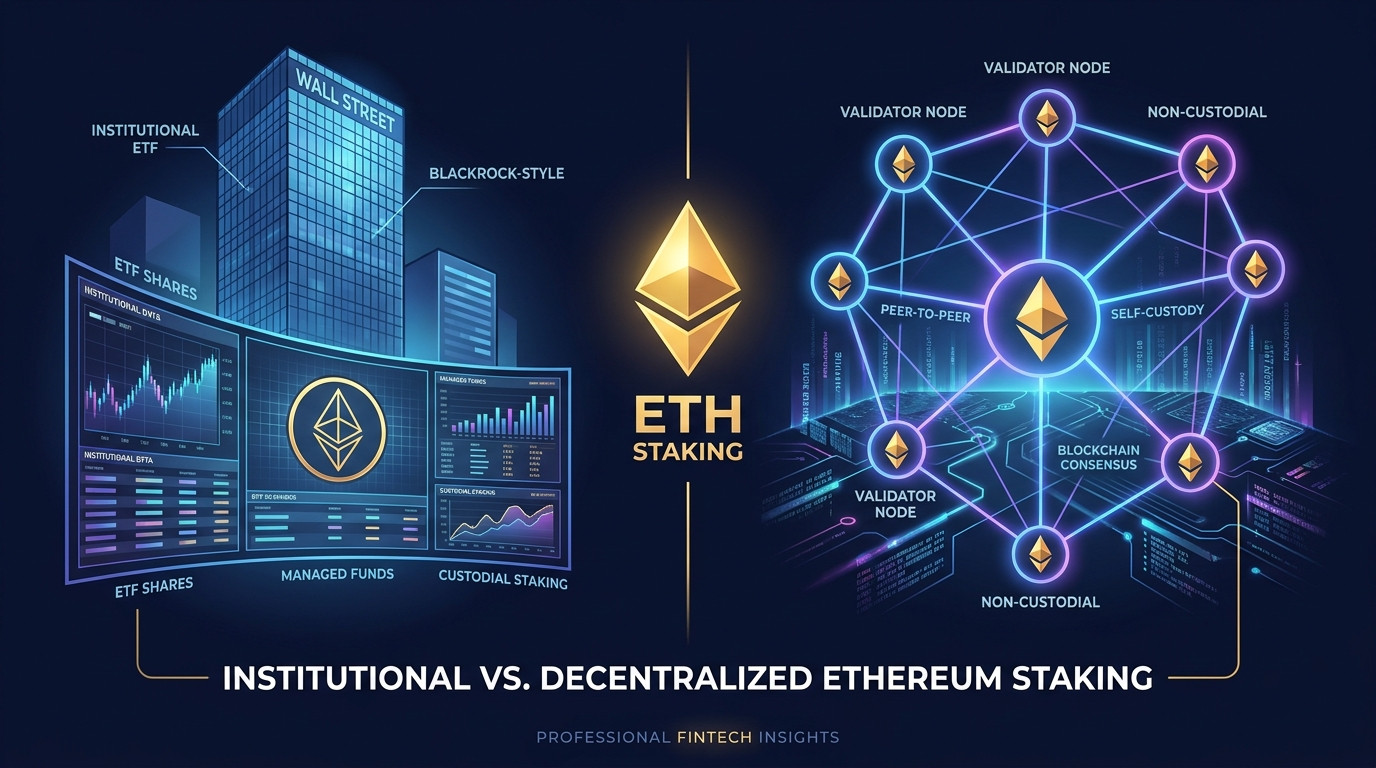
The Institutional ETH Staking Surge Is Here
On March 12, 2026, BlackRock officially listed the iShares Staked Ethereum Trust (ETHB) on the Nasdaq, marking a watershed moment for institutional Ethereum participation. With 37 million ETH — roughly 30–31% of the total supply — already staked and valued between $70 billion and $120 billion, Ethereum staking has become a serious asset class.
For validators, institutions, and serious crypto investors, ETHB represents both an opportunity and a warning. It lowers the technical barrier to earning staking rewards, but it introduces significant fee drag, custodial dependency, and — according to Ethereum's own co-founder — a potential existential risk to the network itself.
What Is BlackRock's ETHB and How Does It Work?
The iShares Staked Ethereum Trust (ETHB) is a spot Ethereum ETF that actively stakes a large portion of its holdings to generate yield for shareholders. Launched on Nasdaq on March 12, 2026, ETHB is the first major U.S.-listed staked ETH product from a traditional asset manager of BlackRock's scale.
The Mechanics Behind ETHB
ETHB allocates 70–95% of its ETH holdings to active staking at any given time. The staking is executed through institutional validators including Figment, Galaxy Digital, and Attestant. Coinbase Prime serves as the custodian and staking execution agent. From an investor perspective, buying ETHB shares gives exposure to ETH price movements plus a portion of staking rewards distributed monthly after fees.
The Hidden Cost: ETHB's Fee Structure Explained
BlackRock and Coinbase collectively retain 18% of all gross staking rewards generated by ETHB. The remaining 82% flows to shareholders. For comparison, Lido Finance charges a 10% fee on staking rewards — ETHB's cut is nearly double.
On top of the staking revenue cut, ETHB charges an annual sponsor fee of 0.25% on total AUM, temporarily waived to 0.12% on the first $2.5 billion for the first year.
The Real Impact on Yield
If Ethereum's base staking yield is approximately 3.0% annually, here is what investors actually receive from each option:
• ETHB: approximately 2.2% net yield after all fees
• Lido (stETH): approximately 2.7% net yield
• Solo validator with MEV: up to 4–5% net yield with no protocol fees
• Professional non-custodial staking with MEV: 3.5–5%+ net yield with full control retained
Yield Comparison: ETHB vs. Solo Staking vs. Liquid Staking
Solo Validator Staking
Running your own validator remains the highest-yield option. Current yields for solo validators range from 2.5–3.0% APY on base rewards, rising to 4–5% APY when MEV-Boost is enabled. Requirements include a minimum of 32 ETH and 24/7 uptime infrastructure. The benefit: zero fees paid to any protocol, full custody of assets, and direct contribution to Ethereum's decentralization.
Lido V3 with stVaults
Lido's V3 upgrade launched on Ethereum mainnet on January 30, 2026, introducing stVaults — modular smart contracts allowing institutions to create customized, isolated staking environments with their choice of validators and fee structures. Current Lido yields sit at approximately 2.4–2.6% net APY after the 10% protocol fee.
ETHB and Staking ETFs
As analyzed above, ETHB delivers approximately 2.2% net yield — the lowest of all major options when fully loaded fees are accounted for. The 21Shares TETH ETF delivers approximately 3.5–4.2% APY, making it more competitive than ETHB on yield.
Exchange and Custodial Staking
Exchanges like Coinbase and Kraken offer yields ranging from 1.9–2.9% APY. Investors sacrifice 1–2% in annual yield for a one-click staking interface and accept full custodial risk.
The Centralization Debate: What Vitalik and Experts Are Saying
ETHB's launch has reignited one of Ethereum's most critical debates: the tension between institutional adoption and network decentralization.
Vitalik Buterin's Warning
Ethereum's co-founder has publicly stated that Wall Street's growing control over ETH staking represents an existential risk to the network. When large, centralized institutions control significant portions of staked ETH, they gain disproportionate influence over validator operations, governance outcomes, and censorship decisions.
ETHB routes its staking through a handful of institutional validators — Figment, Galaxy Digital, and Attestant — with Coinbase as custodian. This means a small number of Wall Street-connected entities collectively control a potentially massive portion of Ethereum's consensus layer.
The Numbers Behind the Risk
BlackRock's existing ETH exposure through ETHA already represents $6–11.9 billion. ETHB's launch-day volume of $15.5 million signals rapid institutional uptake — and rapid concentration risk. As scale grows, Wall Street custodians could control enough of Ethereum's consensus to materially impact its censorship-resistance.
What This Means for Validators
Individual validators and professional staking operators represent the counterweight to this centralization. Every ETH staked through a non-custodial, professionally operated validator is a vote for a more decentralized Ethereum. The decision of how to stake ETH is increasingly ethical and political as much as it is financial.
Who Should Use Staking ETFs (And Who Shouldn't)
ETHB Makes Sense For:
✓ Traditional TradFi investors who hold ETH in brokerage accounts and cannot manage crypto wallets
✓ Pension funds and endowments with regulatory constraints prohibiting direct crypto custody
✓ Retail investors who want staking exposure without any technical involvement
✓ Institutions requiring GAAP-compliant accounting for staking income
ETHB Is a Poor Fit For:
• Validators and institutions who can run their own nodes — you're leaving 0.8–2.8% annual yield on the table
• Investors prioritizing Ethereum's long-term health and decentralization
• Entities with large ETH holdings — the fee drag compounds significantly at scale
• Anyone who values self-custody and doesn't want BlackRock or Coinbase holding their ETH
• DeFi participants who need liquid staking tokens for on-chain strategies
Non-Custodial Staking: The Professional Alternative
What Non-Custodial Staking Actually Means
Non-custodial staking means your ETH never leaves your control. You retain ownership of your withdrawal keys — the cryptographic keys that control access to your staked ETH and its rewards. A professional operator handles the technical complexity of validator management but never gains the ability to access your funds. This is fundamentally different from ETHB, where BlackRock and Coinbase hold your ETH outright.
DVT: The Technical Upgrade That Enhances Safety
Distributed Validator Technology (DVT) distributes a single validator's private key across multiple nodes. If one node goes offline or is compromised, the validator continues operating correctly — eliminating single points of failure that cause slashing or missed attestations. Professional staking operators using DVT provide higher uptime guarantees, lower slashing risk, and better long-term yield consistency compared to any custodial ETF product.
Yield Advantage at Scale
On a 1,000 ETH position at $2,500 per ETH ($2.5 million):
• ETHB at 2.2% net: approximately $55,000 per year
• Non-custodial professional staking at 3.5–5%: approximately $87,500–$125,000 per year
The annual difference of $32,500–$70,000 represents the true cost of choosing ETHB over a professional non-custodial alternative.
How ChainLabo's Approach Differs
At ChainLabo, we have built our staking services around a simple principle: clients should earn maximum yield while maintaining complete control of their assets — the direct opposite of the ETF staking model.
✓ Non-custodial by design: We never take custody of client ETH. Your withdrawal keys remain yours at all times.
✓ DVT-powered infrastructure: We use Distributed Validator Technology to eliminate single points of failure, ensuring higher uptime and reduced slashing risk across all validators we operate.
✓ MEV-Boost enabled: All validators we operate use MEV-Boost to capture additional block rewards, pushing effective yields toward the 4–5% range rather than the 3% base rate.
✓ Transparent, lower fees: Unlike ETHB's layered 18% revenue cut plus 0.25% annual fee, our fees are straightforward and significantly lower, ensuring you capture the majority of your staking rewards.
✓ Supports Ethereum decentralization: Every validator we operate contributes to geographic and technical validator diversity, keeping Ethereum resilient against centralization.
Explore our staking services to see what non-custodial professional staking would yield at your specific ETH holding size.
Key Takeaways and Next Steps
The launch of ETHB marks a pivotal moment for Ethereum staking. Institutional capital is flowing in at unprecedented scale. But the mechanism by which that capital participates matters enormously — for both individual returns and Ethereum's future as a decentralized network.
✓ ETHB's 18% staking revenue cut plus 0.25% annual fee results in approximately 2.2% net yield — the lowest of any major staking option
✓ Solo validators and professional non-custodial staking consistently outperform ETHB by 1.3–2.8% annually — a significant compounding advantage over time
✓ Vitalik Buterin has flagged Wall Street's concentration of validator power as an existential threat to Ethereum's decentralization
✓ Non-custodial staking preserves full self-sovereignty — you retain your withdrawal keys and control of your ETH
✓ DVT technology has made professional non-custodial staking safer and more reliable than ever before
Your Action Plan
1. If you hold ETH in a traditional brokerage: evaluate whether direct staking is legally and operationally feasible for your entity.
2. If you are a validator or institution with 32+ ETH: calculate the annual yield difference between your current staking method and a MEV-enabled non-custodial service.
3. If you are currently using ETHB or planning to: request a direct yield comparison from a professional non-custodial staking provider. At institutional scale, the difference is material.
4. Contact ChainLabo to discuss a non-custodial staking setup that maximizes your yield while keeping you in full control of your Ethereum.





.svg)