
Distributed Validator Technology
DVT-Lite: How Ethereum's Simplified Distributed Validator Technology Is Transforming Staking in 2026


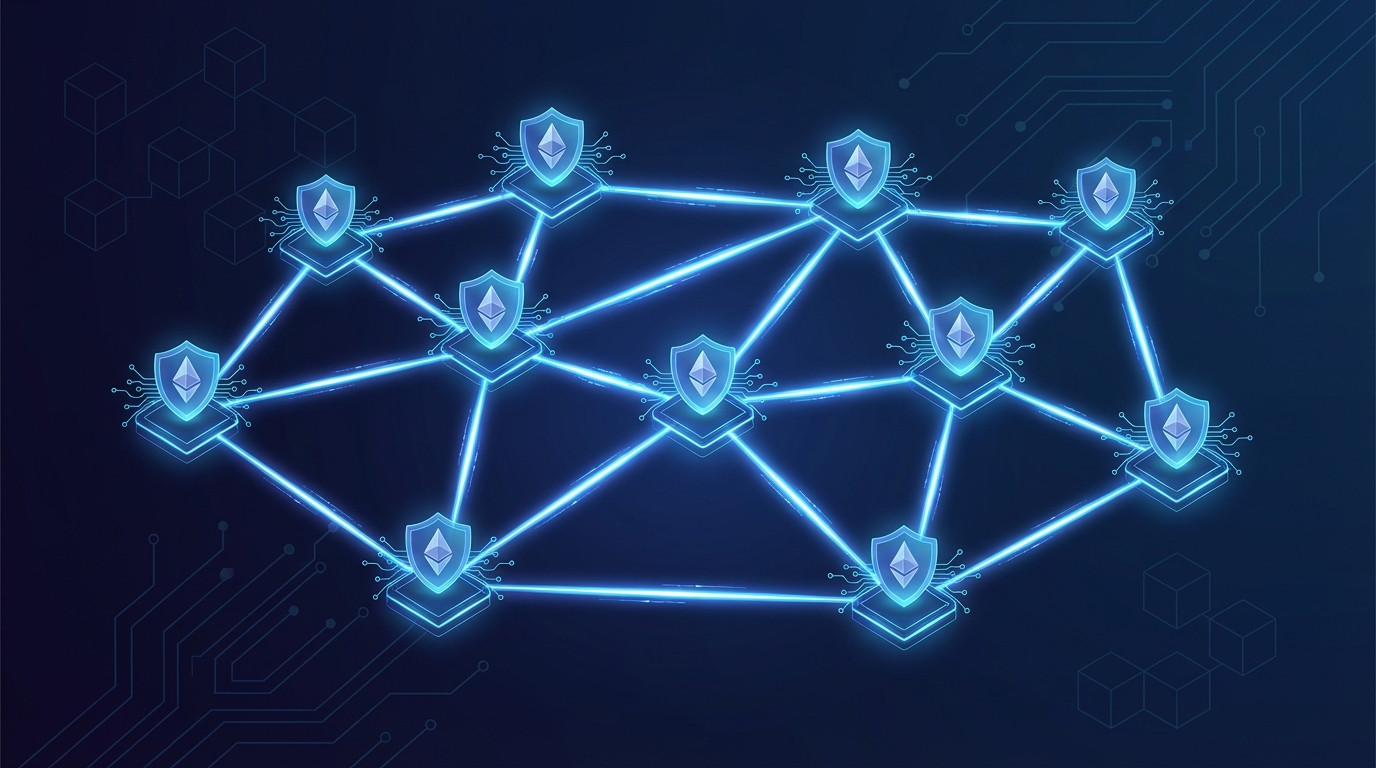
Why DVT-Lite Is the Most Important Ethereum Staking Development of 2026
Ethereum staking has always promised decentralization, but the operational complexity of running validators has quietly pushed power toward large custodial providers. In early 2026, that dynamic began to shift — not through a sweeping protocol upgrade, but through a deceptively simple deployment model called DVT-lite.
When the Ethereum Foundation staked 72,000 ETH using DVT-lite in March 2026, it sent a clear signal: distributed validator technology no longer requires a PhD in cryptographic ceremony design to deploy. With Docker-based one-click setup, automatic node discovery, and BLS12-381 threshold signatures under the hood, DVT-lite is democratizing fault-tolerant staking for solo stakers, professional node operators, and institutions alike.
This article breaks down what DVT-lite is, how it works technically, how it compares to traditional DVT solutions like SSV Network and Obol, and what it means for the future of non-custodial Ethereum staking in 2026 and beyond.
What Is DVT-Lite? Distributed Validator Technology Made Accessible
Distributed Validator Technology, in its traditional form, solves a critical problem in Ethereum staking: a single validator key on a single machine is both a security risk and a single point of failure. If that machine goes offline, your validator misses attestations. If it's compromised, your funds are at risk. DVT addresses this by splitting the validator key across multiple nodes so that no single machine holds the complete key — and a threshold of nodes must cooperate to sign.
Traditional DVT implementations like those from SSV Network and Obol solve this well, but at the cost of significant setup complexity. Key-splitting ceremonies, dedicated peer-to-peer networks, and multi-party coordination overhead have kept these solutions largely in the domain of sophisticated operators.
DVT-lite takes a fundamentally different approach. Rather than splitting the key across nodes and requiring threshold-based reconstruction for every signature, DVT-lite runs the same validator key simultaneously on multiple machines. It achieves fault tolerance not through cryptographic key-splitting at the infrastructure level alone, but through intelligent coordination, threshold signing using Dirk (a distributed remote signing client) and Vouch (a multi-node validator client), and automated node discovery that removes the need for manual peering configuration.
The result is a system that is meaningfully more resilient than a single-node validator setup, dramatically simpler to deploy than traditional DVT, and genuinely viable for a much broader audience of Ethereum stakers.
How DVT-Lite Works: Technical Architecture Explained
Understanding DVT-lite's architecture requires looking at four core components working in concert: Docker-based deployment, auto-discovery, BLS12-381 threshold signatures, and the Dirk/Vouch client stack.
Docker-Based One-Click Deployment
The most immediately visible feature of DVT-lite is its deployment model. The entire validator stack — including the signing infrastructure — is containerized using Docker. Operators can bring up a fully distributed validator setup across multiple machines using a single command, with pre-configured networking and service orchestration handled automatically.
This is a paradigm shift. Previously, setting up distributed signing required configuring multiple independent services, managing certificates and mutual TLS authentication, and carefully orchestrating startup sequences. DVT-lite's Docker composition abstracts all of this into a reproducible, version-controlled deployment artifact.
Auto-Discovery for Node Coordination
Once containers are running, DVT-lite uses auto-discovery protocols to allow the participating nodes to find each other without requiring manual IP configuration or static peering. Nodes broadcast their availability on the local network or defined subnet, and the signing cluster self-assembles. This means adding a new node to increase redundancy is as simple as starting the container on a new machine — the cluster recognizes and incorporates it automatically.
BLS12-381 Threshold Signatures
At the cryptographic core of DVT-lite are BLS12-381 threshold signatures. BLS (Boneh–Lynn–Shacham) signatures are already native to Ethereum's consensus layer, making them a natural fit. In a threshold configuration, a signing quorum — say, 3 out of 5 nodes — must cooperate to produce a valid signature. No single node can sign alone, providing a genuine security improvement over single-key setups.
Critically, the final signature produced is indistinguishable from a standard BLS signature on the consensus layer. The Ethereum beacon chain sees a normal validator signature; the threshold coordination is entirely invisible to the protocol. This means DVT-lite validators are fully compatible with the existing Ethereum network without any protocol changes.
Dirk and Vouch: The Client Stack
Dirk is an open-source distributed remote signing client developed by Attestant. In a DVT-lite setup, Dirk instances run on each participating node and coordinate the threshold signing process. Each Dirk instance holds a key share, and they communicate over mutually authenticated TLS to produce combined signatures without any single node ever possessing the complete key during the signing process.
Vouch, also from Attestant, is the validator client layer that sits above Dirk. Vouch handles all beacon chain duties — attestations, block proposals, sync committee participation — and delegates signing requests to the Dirk cluster. This separation of concerns between validator logic (Vouch) and key management (Dirk) creates a clean, auditable architecture.
Together, Dirk and Vouch form a production-grade distributed validator stack that DVT-lite packages into an accessible deployment model. This is not a prototype — it is battle-tested infrastructure made dramatically easier to operate.
DVT-Lite vs Traditional DVT: SSV Network and Obol Compared
To appreciate what DVT-lite achieves, it helps to understand what it simplifies compared to existing distributed validator technology solutions.
Key-Splitting Ceremonies
Both SSV Network and Obol require a distributed key generation (DKG) ceremony — a multi-party cryptographic process in which the validator key is never assembled in one place. Instead, key shares are generated cooperatively across nodes from the start. This is cryptographically elegant but operationally demanding: all participants must be online simultaneously, ceremony tooling must be coordinated, and errors require restarting the process.
DVT-lite does not eliminate key sharing entirely — Dirk distributes key shares across nodes — but the process is dramatically simplified within its Docker deployment model, removing the multi-party ceremony overhead.
Dedicated P2P Networks
SSV Network operates its own peer-to-peer network of operators, and Obol has its Charon middleware layer facilitating inter-node communication. These dedicated networks add latency, introduce additional infrastructure to monitor, and require stakers to integrate with external operator ecosystems.
DVT-lite's auto-discovery model operates within the operator's own infrastructure. There is no external P2P network dependency — nodes communicate directly, reducing attack surface and operational complexity.
Operator Coordination Overhead
Using SSV or Obol typically means distributing your validator key management across nodes run by different parties — which is excellent for maximum decentralization but introduces coordination overhead, service agreements, and trust considerations with third-party operators.
DVT-lite is optimized for operators who want to run their own distributed cluster — multiple machines under their control — rather than outsourcing key management to a marketplace of external operators. For non-custodial staking providers and sophisticated solo stakers, this is often the preferred trust model.
Summary Comparison
• SSV Network: Maximum decentralization, third-party operators, DKG ceremony required, dedicated P2P network, higher complexity
• Obol: Charon middleware, DKG ceremony, strong community tooling, well-suited to cluster of trusted operators
• DVT-lite: Single-operator multi-machine deployment, Docker-native, auto-discovery, simpler key distribution, minimal external dependencies
DVT-lite is not a replacement for SSV or Obol in every context — but it fills a critical gap for operators who want distributed fault tolerance without distributed operator trust.
The Ethereum Foundation's 72,000 ETH Deployment: What It Signals
In early March 2026, the Ethereum Foundation deployed DVT-lite with a stake of 72,000 ETH — approximately 0.06% of Ethereum's circulating supply. Validators went live around March 19, 2026, marking the most prominent real-world deployment of DVT-lite to date.
This deployment matters for several reasons beyond the technical validation it provides.
Institutional Signal
The Ethereum Foundation is not a retail staker experimenting with new tooling. Its decision to stake 72,000 ETH using DVT-lite communicates that the technology is ready for significant capital deployment. For institutional stakers evaluating whether DVT-lite is production-ready, this is the most credible possible endorsement.
Alignment with Vitalik's Vision
In January 2026, Vitalik Buterin proposed native DVT integration at the protocol level — a design in which validators could represent up to 16 virtual identities per physical validator. This would allow one staker to run a distributed validator cluster while appearing as a single entity to the beacon chain, further simplifying the operational model.
The Foundation's DVT-lite deployment is consistent with this direction: demonstrating the value of distribution at the application layer while the protocol-level integration is designed. By the time native DVT lands in the protocol, there will already be a generation of operators experienced with the DVT-lite operational model.
Network Health Implications
Every validator running DVT-lite rather than a single-node setup improves Ethereum's overall liveness and censorship resistance. When nodes go offline during client updates, hardware failures, or datacenter outages, DVT-lite validators continue attesting while single-node validators miss duties and accumulate inactivity penalties. Wider DVT adoption makes Ethereum more robust at the network level — not just at the individual operator level.
Institutional Staking Momentum: BlackRock ETHB and EigenCloud
DVT-lite is arriving at a moment of significant institutional momentum in Ethereum staking. Two developments in early 2026 illustrate the scale of capital now flowing into this space.
BlackRock's iShares Staked Ethereum Trust (ETHB)
In March 2026, BlackRock launched the iShares Staked Ethereum Trust (ETHB) on Nasdaq — a regulated, exchange-traded product that passes through 82% of staking yield to investors. ETHB allows traditional investors to access Ethereum staking returns within a familiar equity-like wrapper, without ever interacting with a validator or managing a wallet.
The significance of ETHB for the broader DVT-lite narrative is indirect but important: as institutional capital flows into Ethereum staking through products like ETHB, the node operators providing the underlying staking infrastructure face increasing pressure to demonstrate robust, fault-tolerant validator operations. DVT-lite is precisely the kind of infrastructure upgrade that serious institutional-grade operators need to adopt.
EigenLayer Becomes EigenCloud
In early 2026, EigenLayer rebranded to EigenCloud and expanded its restaking vision with the launch of EigenAI and EigenCompute — services that use restaked ETH to provide verifiable compute for AI workloads and general computation. This represents a significant evolution of the restaking model: ETH staked in validators is not just securing consensus, but also powering a broader ecosystem of verifiable off-chain services.
For DVT-lite operators, the EigenCloud expansion is relevant because fault tolerance at the validator level becomes even more critical when validators are also securing additional services. A validator running DVT-lite that suffers no downtime is worth more in an EigenCloud context than one that periodically goes offline, because downtime penalties can propagate across multiple restaked services simultaneously.
What DVT-Lite Means for Non-Custodial Staking Providers
For non-custodial staking providers — operators who run validators on behalf of clients while clients retain control of their withdrawal credentials — DVT-lite is both an opportunity and an expectation.
The opportunity is clear: operators who adopt DVT-lite can offer materially better uptime guarantees, demonstrate more sophisticated infrastructure, and credibly compete with larger custodial alternatives that have historically benefited from their scale providing implicit redundancy.
The expectation is emerging: as DVT-lite becomes better understood, sophisticated clients will begin asking their staking providers whether they operate distributed validator setups.





.svg)